

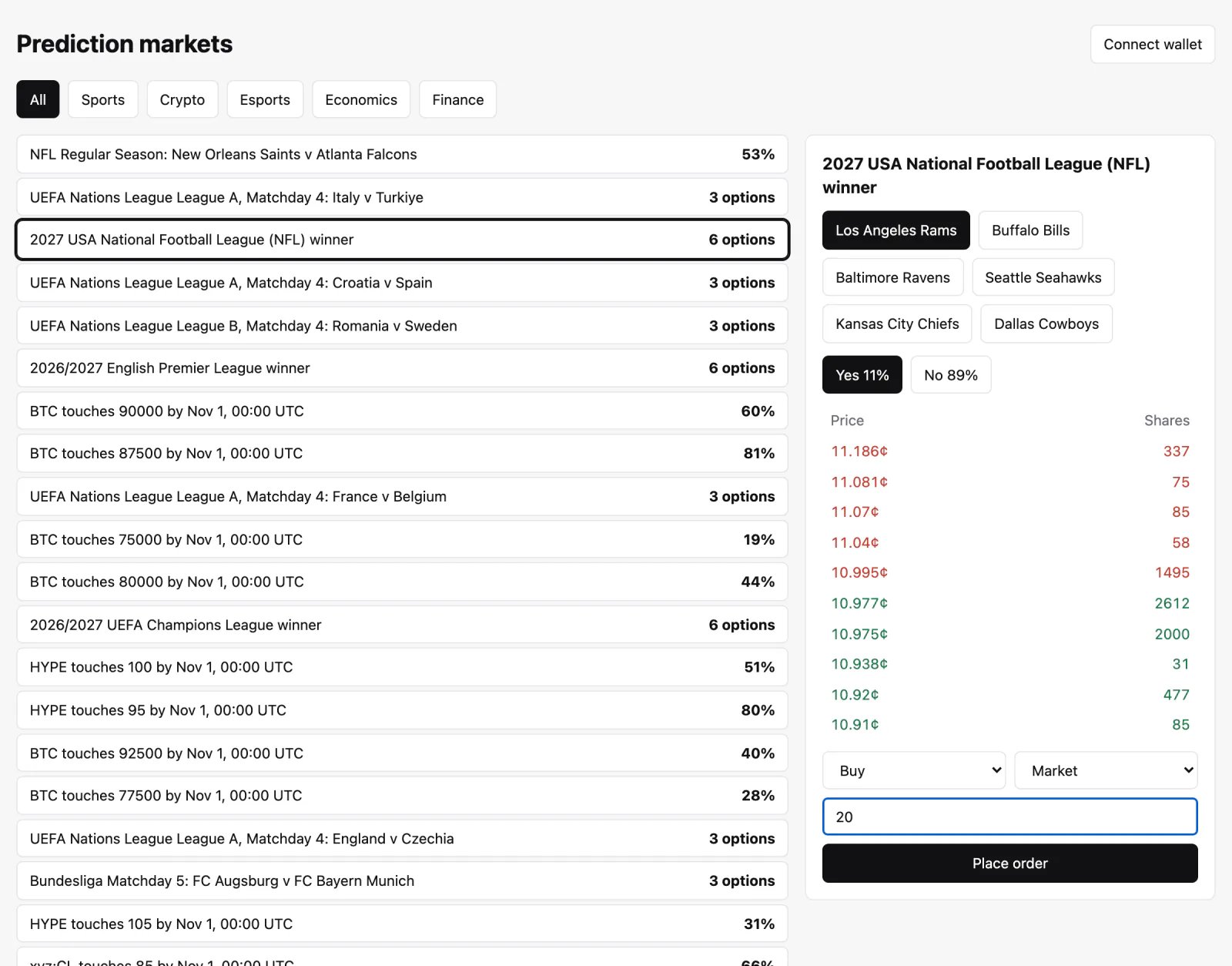
Markets on the left. The selected market's order book and order ticket on the right.
What you need
@outcome.xyz/hip41.3.0 or later, and viem.- For your users: a browser wallet such as MetaMask or Rabby, or an embedded wallet with an EIP-1193 provider, and USDC on Hyperliquid. See Funding your account.
- To earn a builder fee: a builder address with at least 100 USDC of perps account value on Hyperliquid.
Who signs what
Users keep custody. Their wallet signs a few approvals, and a session key signs every order.- The session key, which Hyperliquid calls an agent or API wallet, is a private key your page generates in the browser. It can place and cancel orders for the user. It can’t withdraw or transfer funds.
- The example keeps it in memory, so a reload means approving a new one. An account can have 3 named agents. Approving the same name again replaces the previous agent, so sessions don’t use up the slots.
- Wallet approvals are signed for Arbitrum (chain id 42161), or Arbitrum Sepolia (421614) when the adapter uses testnet. Wallets refuse to sign for another chain, so switch the wallet first, and pass
isMainnetto the approval helpers so they match the network.
Funds
Outcome trades use the user’s USDC spot balance. On a standard Hyperliquid account, deposits land in the perps balance, so the user moves USDC to spot first. Unified accounts have one balance and skip this step.Orders
- A price is a probability between 0 and 1, with at most 5 decimals. Buying Yes at
0.71costs 71 cents a share. The SDK rounds a limit price to that tick when it sends the order. - Shares are whole numbers. Each winning share pays 1 USDC.
- An order must be worth at least 1 USDC (
MIN_NOTIONAL). - The two sides of a market share one order book: a Yes bid at 0.71 is a No ask at 0.29.
type: "market"sends Hyperliquid’sFrontendMarketorder at 0.99999 to buy or 0.00001 to sell. outcome.xyz instead sends an IOC limit order at a slippage price; to do the same, sendtype: "limit"withtimeInForce: "FAK".placeOrderdoesn’t throw. Checksuccess. When Hyperliquid rejects an order,errorcarries its message. When it rejects the whole request, for example because the agent isn’t approved,rawcarries the message.cancelOrderdoesn’t throw on a rejection either. Check thatstatusis"ok"and that every entry inresponse.data.statusesis"success"; a failed entry is{ error }.- Trading fees are in Fees.
Builder fee
A builder code lets you charge a fee on the orders your site sends. The fee is in tenths of a basis point:10 is 0.01%, and 1000 (1%) is the maximum on spot markets such as HIP-4 outcomes. Hyperliquid doesn’t charge builder fees on the buy side of spot trades, so you earn on your users’ sells. Each user approves your maximum fee once, and can approve up to 10 builders.
Run the example
The example is in the SDK repository, inexamples/web-trading. Walk through its code in Full trading integration code.
http://localhost:5173 in a browser with a wallet extension. To charge a builder fee, set BUILDER in src/trading.ts.
Before you go live
- Hyperliquid allows 1,200 request weight per minute per IP, and these requests run in each user’s browser. The example uses about 260 a minute.
- If you store the session key to survive reloads, treat it as a secret. It can’t withdraw, but it can trade.
- Outcome isn’t available in some jurisdictions. See Risks.
Troubleshooting
Must deposit before performing actions
Must deposit before performing actions
The wallet has no Hyperliquid account yet. The user deposits USDC on Hyperliquid first. The example checks this with
userRole when the wallet connects.User or API Wallet 0x... does not exist
User or API Wallet 0x... does not exist
The session key isn’t approved, or a newer session replaced it. Approve a new one.
The wallet refuses to sign
The wallet refuses to sign
The wallet is on another chain. Approvals are signed for Arbitrum (chain id 42161), or Arbitrum Sepolia (421614) on testnet.
Orders fail although the user has USDC
Orders fail although the user has USDC
The USDC may sit in perps. Move it to spot.
Next steps
- Full trading integration code
- Trading, for every option of
placeOrderandcancelOrder